

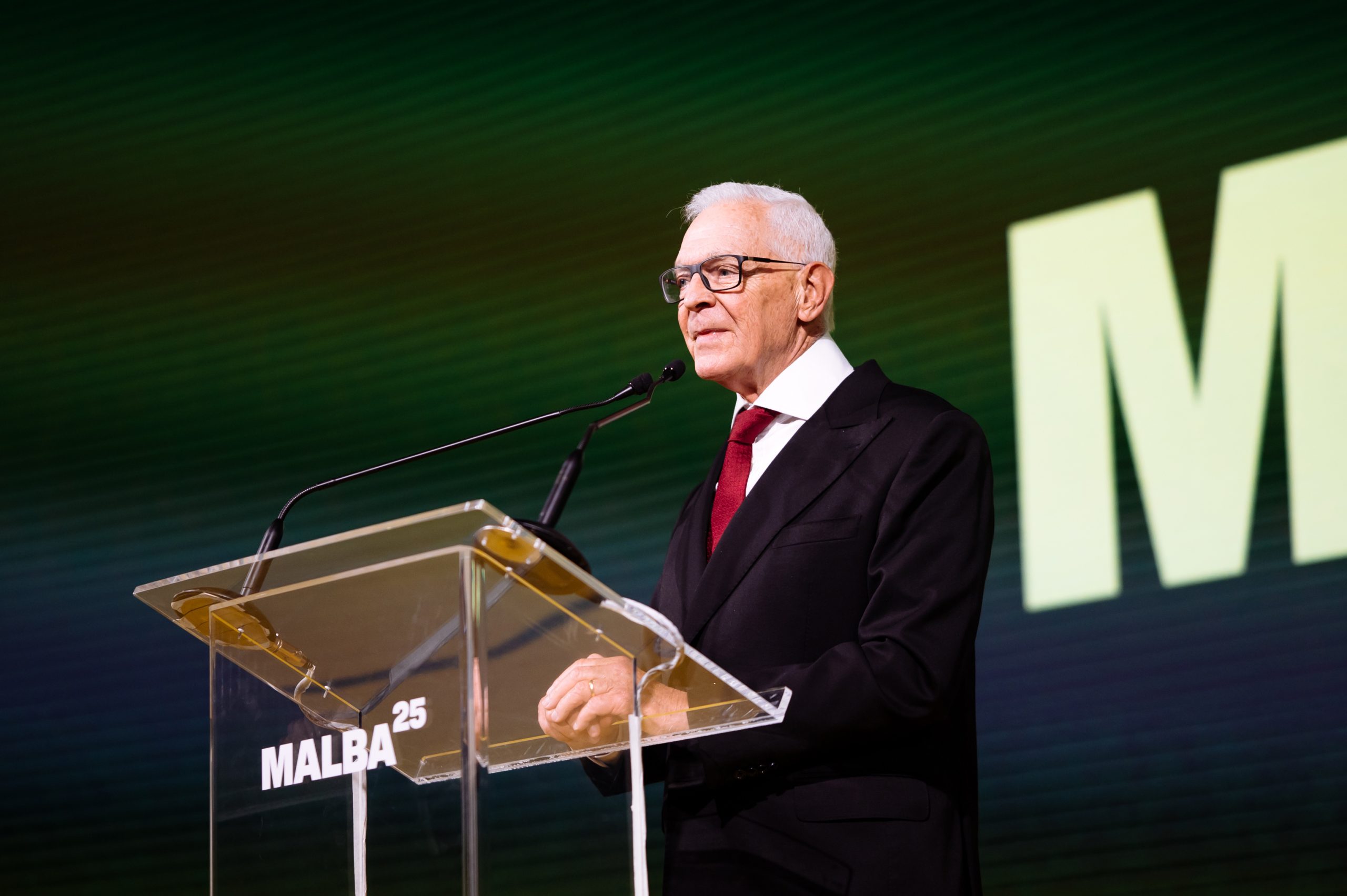
Buenos Aires, 18 de septiembre de 2026 — As part of its 25th anniversary celebrations, Malba held a private gala last night attended by nearly 600 prominent figures from the cultural world, including artists, collectors, business leaders and philanthropists from Argentina and abroad. During the event, the museum's founder and chairman, Eduardo F. Costantini, made a series of announcements that rank among the most significant in the institution's history and mark the beginning of a new phase of development.
First, he confirmed plans to expand the museum beneath Plaza Perú, doubling its exhibition space, and announced the international architecture firm selected to lead the project: Frida Escobedo Studio, based in New York and Mexico. Following his remarks, he invited architect Frida Escobedo to the stage to present the preliminary project to gala guests. The expansion is now in the design phase and is expected to open in late 2029 or early 2030. It will add new temporary exhibition galleries, a new auditorium, multipurpose spaces, an outdoor plaza courtyard, workshops, storage areas and offices. In Frida Escobedo's words: “The project is not simply about expanding the available space, but about transforming the museum as a whole and creating new relationships among the programs that have made Malba what it is today.” The new exhibition galleries will coexist with spaces designed specifically for film, literature, education and public programs. The auditoriums and multipurpose spaces may be incorporated into the museum's general visitor route or operate independently, allowing a screening, a conversation, an educational activity or an event to take place simultaneously or even outside regular opening hours. This represents an expansion not only of the museum's physical space, but also of its day-to-day presence in the city's cultural life. Escobedo added: “The relationship with the city's public space beneath Plaza Perú is one of the project's central elements. Malba gains the space it needs to grow, while the plaza retains its character as an open public space.” Frida Escobedo Studio has extensive experience in the cultural sector and is currently leading the comprehensive renovation of the Centre Pompidou, the Modern and Contemporary Art Wing of the Metropolitan Museum of Art in New York (The Met), and the new complex for the headquarters of Qatar's Ministry of Foreign Affairs.
Second, Costantini announced the donation to the museum of the Daros Latinamerica Collection, acquired in January 2026 and comprising 1,232 works by 117 artists from the region, produced primarily between the 1950s and the 2010s. He also announced the donation of 17 works of Latin American modern art worth millions of dollars, which he had added to his personal collection in recent years. The works that will become part of Fundación Malba's holdings are: Diego y yo [Diego and I] (1949) by Frida Kahlo, the last bust-length self-portrait the Mexican artist painted before her death; Baile en Tehuantepec [Dance in Tehuantepec] (1928) by Diego Rivera, considered one of the muralist's most important easel paintings; The Distractions of Dagobert (1945) by Leonora Carrington, one of the renowned Surrealist artist's most significant works; and Carrington's monumental sculpture La Grande Dame (1951). Remedios Varo is represented by the paintings Simpatía (La rabia del gato) [Sympathy (The Cat's Rage)] (1955) and Armonía [Harmony] (1956). Cuban artist Wifredo Lam is represented by Omi Obini (1943), from his series of anthropomorphic landscapes. Bachué (1925), a sculpture of the mother goddess from Chibcha mythology by Colombian artist Rómulo Rozo, joins other major sculptures of Latin American modernism, including Pudor [Decency] (1922) and Tocadora de banjo [Banjo Player] (1925) by Italian-Brazilian artist Victor Brecheret, and Cobra grande [Big Snake] (1943) by Brazilian artist Maria Martins. The Malba Collection will also receive the paintings O urso [The Bear] (1925) by Vicente do Rego Monteiro, Soldados Mexicanos [Mexican Soldiers] (1930) by José Clemente Orozco, Consumatum est (1942) by Juan O'Gorman, Coloritmo 8 (1956) by Alejandro Otero, and two paintings by Bolivian artist Alejandro Yllanes: Tragedia del Pongo (1932) and Wiraqucha Danzante (Carnival of Oruro) (1941). With these additions, the Malba–Costantini Collection of modern and contemporary Latin American art, which began in 2001 with 223 works donated by its founder, now comprises approximately 3,000 works, placing it among the world's most important and extensive collections of Latin American art.
Another major announcement that evening was the establishment of the Malba Art Trust by Eduardo Costantini, the museum's founder and chairman, with an initial contribution of USD 50 million to safeguard the institution's continuity and future. Costantini currently contributes between USD 3 million and USD 4 million each year to cover the museum's operating deficit. This initial fund will support the continuity of the museum's exhibitions, programming and general operations over the long term. Alongside the announcement, Eduardo Costantini invited those present and patrons around the world to join the initiative with additional contributions so that the museum can endure for generations to come.