02.25 — 03.25.21
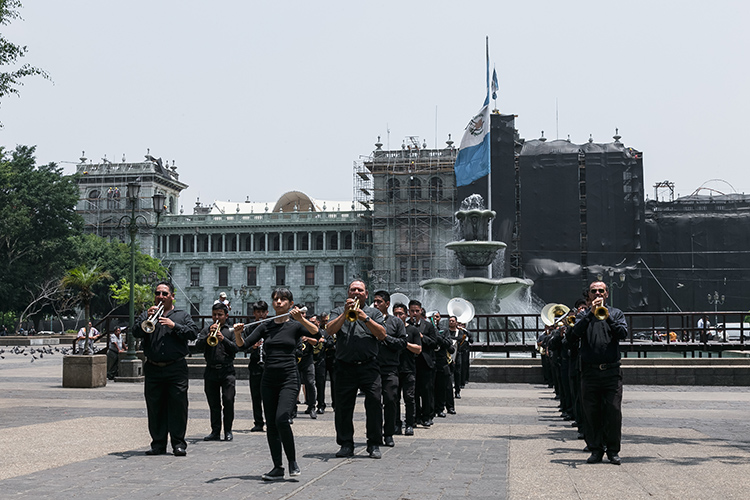
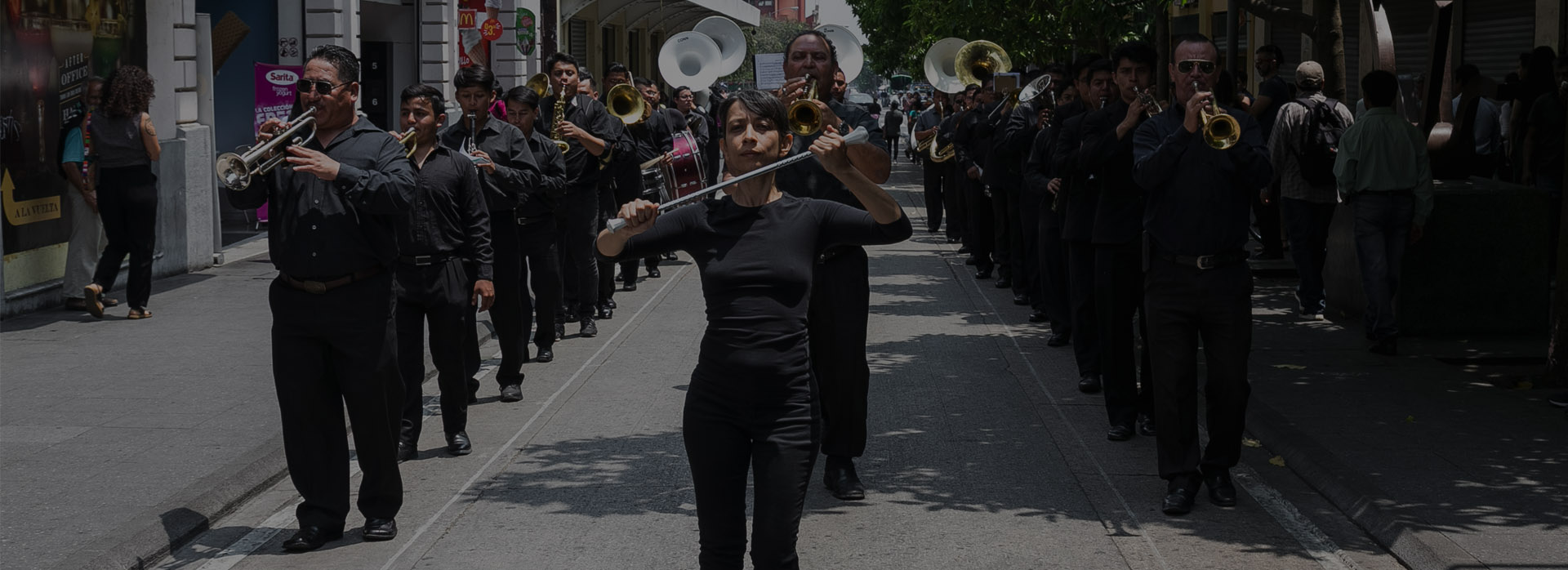
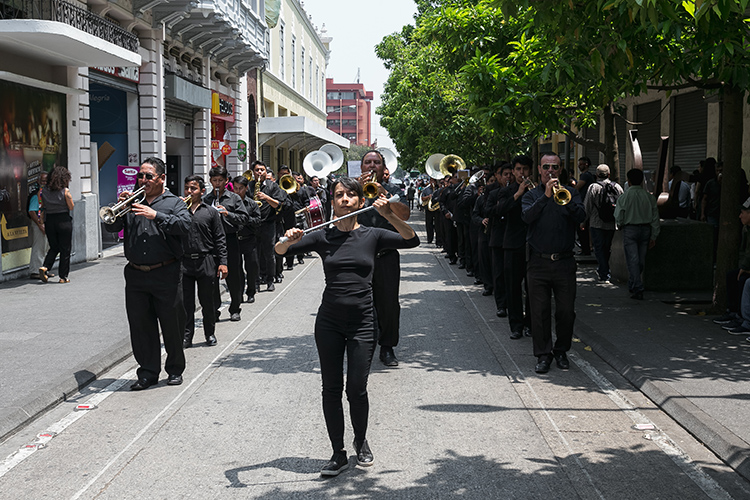
Sixth exhibition of the program History as Rumor, dedicated to the performance El gran retorno (2019) by artist Regina José Galindo (Guatemala City, 1974). On Thursday, April 25, a band of 40 professional musicians marched backward through the center of Guatemala City while playing military marches. The band made its way from the Ministry of the Interior to the National Palace, two places of significant political importance.
In contrast to the flashy, colorful outfits usually worn by members of musical bands, the group was dressed in black, turning what is usually a festive event into a kind of funeral. The artist participated in the parade, walking backwards and holding a cane upright. The performance speaks to the socio-political regression affecting Guatemala, but which is also being experienced on a global scale.
Data Sheet
Colaborators: Idurre Alonso (Getty Research Institute) and Arnoldo Galvez Suárez
Witnesses: Steff Arreaga and José Luis Ovalle.
Rumoristas: Rosina Cazali, Eugenio Merino and Avelino Sala.
Regina José Galindo (1974)
She is a visual artist and poet who uses performance as her primary medium. Galindo lives and works in Guatemala, using her own context as a starting point to explore and denounce the ethical implications of social violence and injustices related to racial and gender discrimination, as well as human rights abuses stemming from endemic inequalities in power relations in contemporary societies. Galindo is, in the words of Loris Romano, “an artist who pushes beyond her own limits through radical, disturbing, and ethically uncomfortable performances.”
Galindo received the Golden Lion Award for Best Young Artist at the 51st Venice Biennale (2005) for her work “Who Can Erase the Traces” and “Hymenoplasty,” two crucial pieces in her oeuvre that criticize Guatemalan violence stemming from erroneous concepts of morality, as well as gender violence, while demanding the restoration of the memory and humanity of the victims. In 2011, she received the Prince Claus Award from the Netherlands for her ability to transform injustice and outrage into public acts that demand a response.
Regina participated in the 49th, 53rd, and 54th Venice Biennales; Documenta 14 in Athens and Kassel, the 9th International Biennial of Cuenca, the 29th Ljubljana Biennial of Graphic Arts, the Shanghai Biennial (2016), the Pontevedra Biennial (2010), the 17th Sydney Biennial, the 2nd Moscow Biennial, 1st Auckland Triennial, The Venice-Istanbul Exhibition, the 1st Canary Islands Art and Architecture Biennial, the 4th Valencia Biennial, the 3rd Albania Biennial, the 2nd Prague Biennial, and the 3rd Lima Biennial.
History as Rumor
Multiple movement performances
On the occasion of the celebration of its nineteenth anniversary, Malba presents La historia como rumor (History as Rumor), an annual program of online exhibitions created by Gabriela Rangel, Malba’s artistic director, with the aim of documenting and contextualizing a set of performances that took place at different times and in various places in the Americas and the Caribbean, in a historical transition period marked by the end of the Cold War and the advent of the internet.
A collaboration between guest curators and various international museums and institutions is the starting point to present a research project every month that will allow us to revisit a series of actions and performances that became production milestones of their time, and that will engage in a direct or indirect conversation with problem areas of the present. A video record of testimonies from spectators who witnessed those performances, and of experts from different disciplines giving their opinion on them, will create an archive that will make up the oral history for each of the projects.
The selection of artists and specific actions respond to a very broad framework that began to be debated regionally in 1981, at the First Latin American Colloquium on Non-Objectual Art and Urban Art at the Museum of Modern Art in Medellin, Colombia. The starting point of the selection also understands the historical transmission of performances as a rumor, defined as a multiple movement in a diagram sketched by Ulises Carrión, Mexican poet and visual artist based in Amsterdam. Both frameworks propose the reconfiguration of a set of works in a period of time influenced by the conceptualisms that began globally since the 1960s.
The exhibition of each performance includes a record of the action, along with vast archival material, such as photographs, films, storyboards, press clippings and documents that aid the reconstruction of the piece and its context. It also includes an interview with someone who has witnessed the performance and four video testimonies by leading specialists from different disciplines. The choice of the various voices and materials is intended to recontextualize these performances in the present as contemporary expressions.
The series La historia como rumor will be available until September 21st, 2021 along with Malba’s 20th Anniversary celebration.
Opening conversation
Thursday, February 25, 6:00 p.m.
Presents: Gabriela Rangel
Regina José Galindo in conversation with Idurre Alonso y Arnoldo Gálvez Suárez.
Institutional Colaborator:

Main support:

Ingreso a la Colección Malba
In 2019, Regina José Galindo joined the Malba Collection thanks to the addition of the video Hilo de tiempo (2012), purchased by the museum's Acquisitions Committee. Commissioned by the Hemispheric Center for Performance and Politics in Chiapas, it was first presented in San Cristóbal de Las Casas, Mexico, and was part of the documentary exhibition Ocote: miradas encendidas. The video begins with the presence of a body lying on the ground in the Plaza de la Paz, a few steps from the Cathedral in San Cristóbal de Las Casas. The artist is inside a black woven body bag, and the audience must unravel the bag to free the body; once Galindo is completely uncovered, she gets up and leaves. Along with the video, the following caption appears on the artist's website:
We must go back in time to find the reason for so much death and thus find life.
My body remains hidden inside a woven body bag. The audience is free to unravel the bag until they discover the body.