11.26.2010 — 02.07.2011
Curator: Victoria Noorthoorn
Malba – Fundación Costantini presents a retrospective exhibition of Argentine artist Marta Minujín featuring more than 100 works focused on her historical production from the sixties, seventies and eighties. Curated by Victoria Noorthoorn, the exhibition invites viewers to witness the complexity and scope of the production of an artist who, the curator suggests, “is all about freedom, excess, self-involvement, celebration, and pure creativity and, contrary to what we might imagine, is also about precision, rigor, endurance, generosity and critical spirit. She is a self-manager of artistic projects the likes of which Argentina has never seen before”. Furthermore, “the aim of this exhibition is to assert the critical nature of Minujín’s work and emphasize her ongoing relevance. It presents a Minujín we are not entirely familiar with due to the historical lack of analytic exhibitions of her work in Argentina”.
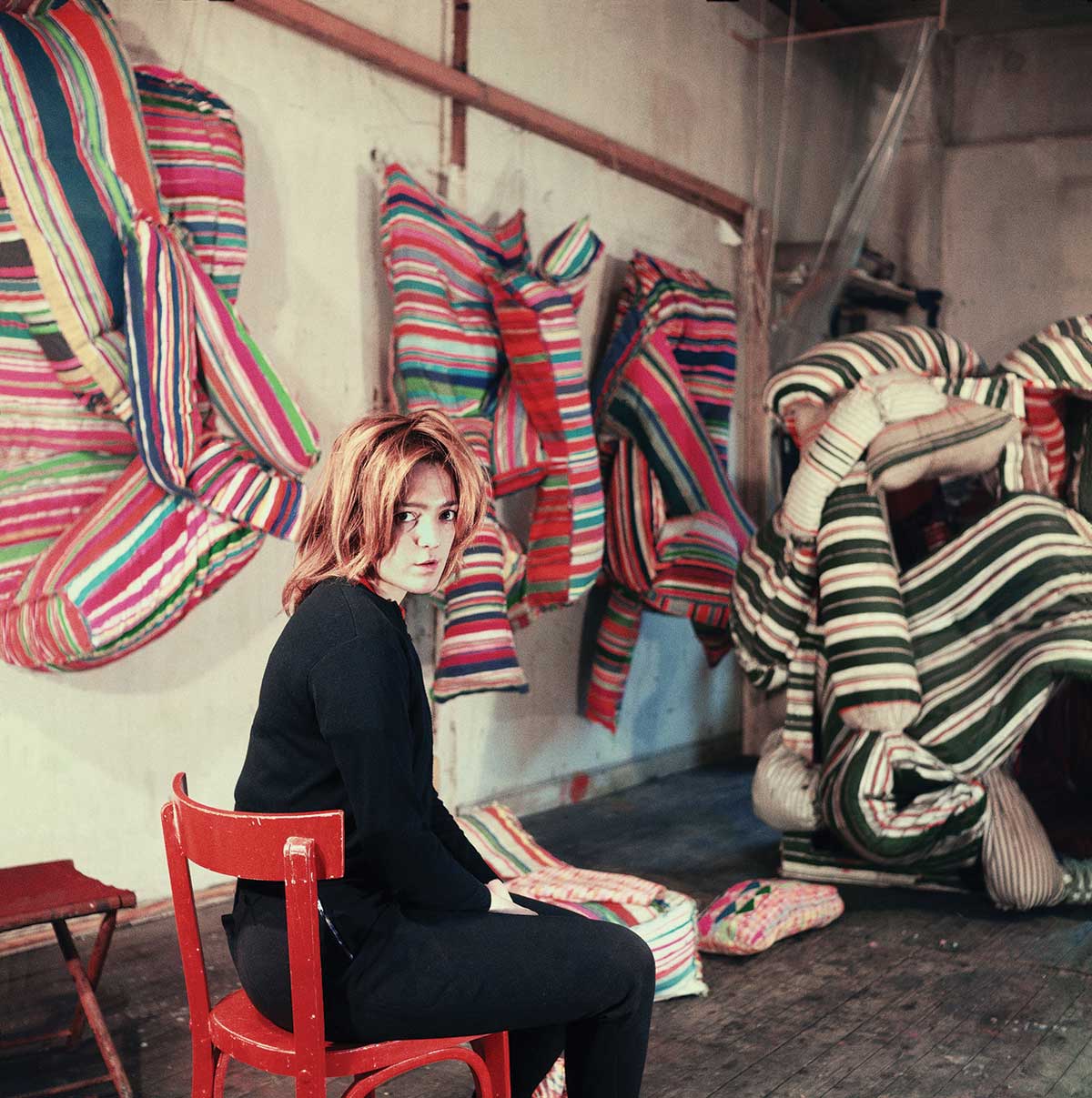
Organized chronologically, the exhibition includes her early paintings and Informalist works from 1959 to 1961; participatory environments from 1964 and 1965; experiments with the mass media carried out in 1966; works based on her hippie experiences in the late sixties; fictional operas from 1972; critical projects related to the political situation in Latin America from the late seventies; and projects involving mass participation and the destruction of myths produced in the eighties.
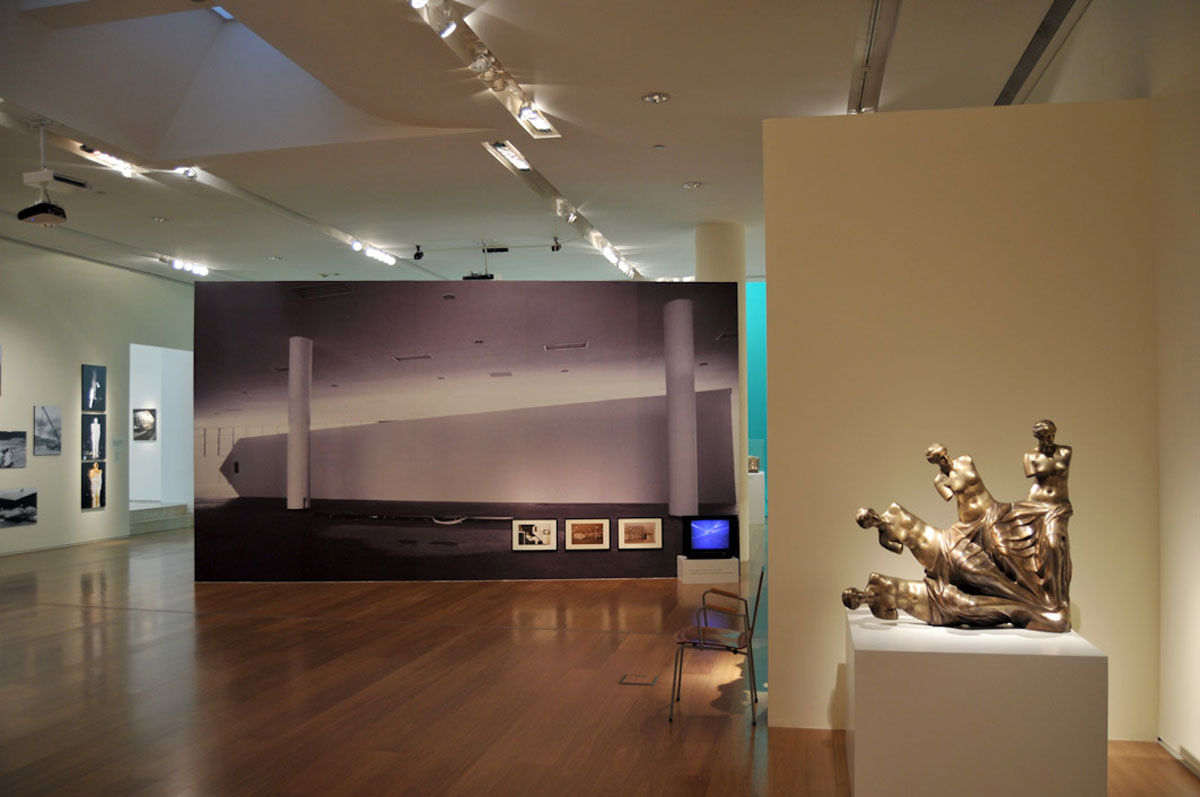
The exhibition design, with its curved panels, is suggestive of Minujín’s labyrinths. It presents artworks from private and public collections, twenty film projections, the reconstruction and recreation of historical works, and several important documents from the artist’s prolific archive.
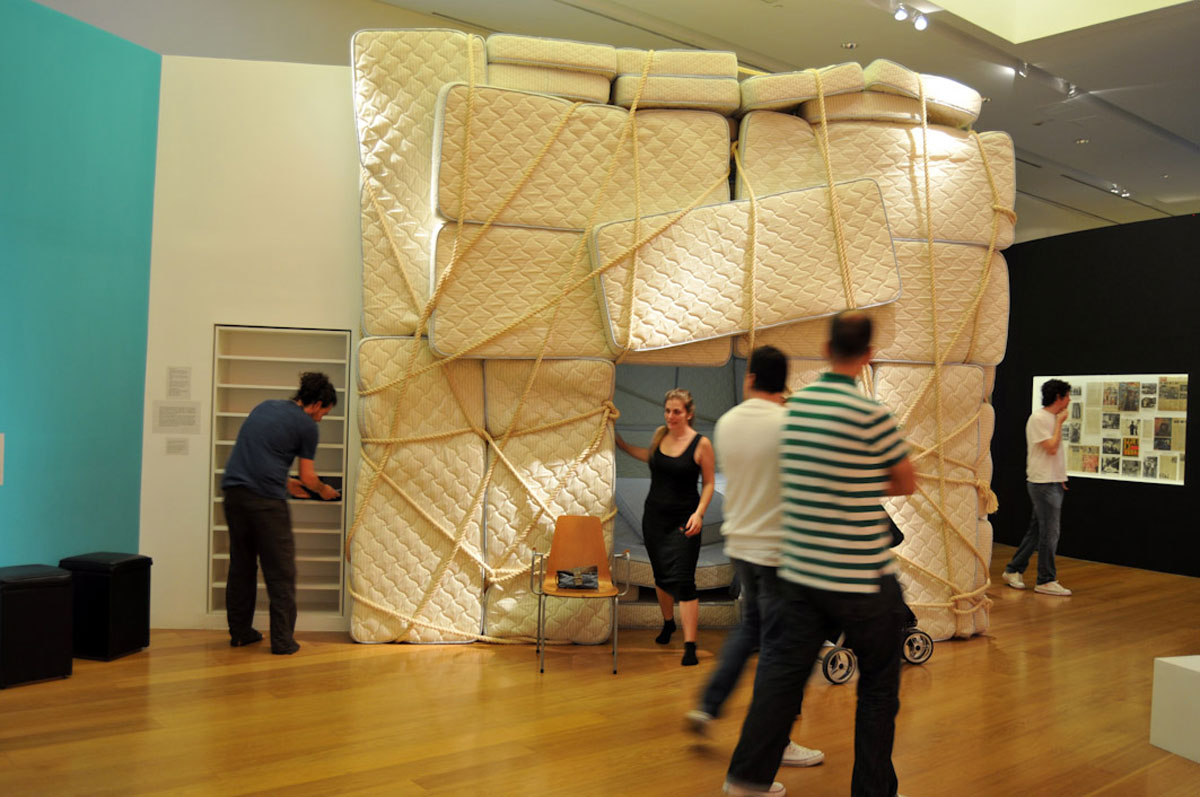
Many of Minujín’s most paradigmatic works are represented in this exhibition, including La destrucción (The Destruction, 1963), ¡Revuélquese y viva! (Wallow Around and Live!, 1964), La Menesunda (Mayhem, 1965), El Batacazo (The Long Shot, 1965), Simultaneidad en Simultaneidad (Simultaneity in Simultaneity, 1966), Importación-Exportación (Import-Export, 1968), Kidnappening (1973), The Soft Gallery (1973), Imago Flowing (1974), La academia del fracaso (The Academy of Failure, 1975), Comunicando con tierra (Communicating with Earth, 1976), El Obelisco de pan dulce (The Obelisk in Sweet Bread, 1979), El Partenón de libros (The Parthenon of Books, 1983) —made from books that had been confiscated during the military dictatorship—, Operación Perfume (Operation Perfume, 1987) and many others. Malba also presents a selection of sculptures produced by the artist during the last 20 years is also on exhibit on the museum’s terrace.
The exhibition presents Minujín in dialogue with her time, with the national and international events taking place at different moments in her career and with the artistic communities with which she worked, whether in Argentina or elsewhere. It reflects the way that her production set forth a dialogue with the diverse movements of the sixties, and specifically with New Realism, Pop Art, and Conceptual Art, as well as with the investigations around performance, happenings, video-art, new technologies, mass media, and action art, among others. Minujín responds to these events time again.
In conjunction with the exhibition, Malba has published a 300-page bilingual (Spanish-English) catalogue with full-color reproductions of the works on display. The catalogue also includes an introduction by Eduardo F. Costantini, founder and president of Malba; a curatorial essay by Victoria Noorthoorn ("The Vertigo of Creation"), as well as several essays written by a group of researchers: a "Biography", by Javier Villa; a "Bibliography", by Cristina Blanco, a section on specific "Artworks", with texts by Jimena Ferreiro Pella; the "International Art Timeline", by Victoria Giraudo; and a "Documents" section, with a selection of historical texts.
The research and curatorial proposal
This exhibition invites the viewer to take another look at emblematic projects by Minujín, heeding aspects perhaps previously unnoticed, while also presenting lesser known works and projects. According to the curator, the exhibition does not aspire to cover her entire production, but rather “to give rise to a more flexible vision of it so that the viewer and the reader might begin to discover hitherto unthinkable dimensions of Minujín’s work”.
Accordingly, the primary sources of information for the research –both for the exhibition and the catalogue– were the (few) existing works by Minujín and, most importantly, the artist’s archive. Thanks to photographic recordings and other documentation, it was possible to recover information about dynamic works –objects, constructions, lounges and actions– largely conceived to be experienced by a viewer.
In this exhibition and catalogue, Victoria Noorthoorn stresses three salient characteristics: “The artist’s ability to constantly redefine artistic categories, thus resisting all categorization; the various ways in which she conceives of her practice on a world scale; and her fundamental conviction of the need to affirm, at every instant, a total freedom of thought and expression. Together, these variables resulted in a body of work that challenged the status quo of a conservative society, as well as established artistic conventions and exhibition formats, and the accepted narratives of our local historiography. In sum, Minujín has critically addressed the various contexts in which her work was produced, even signaling and denouncing diverse political realities”.