

Digital_Project
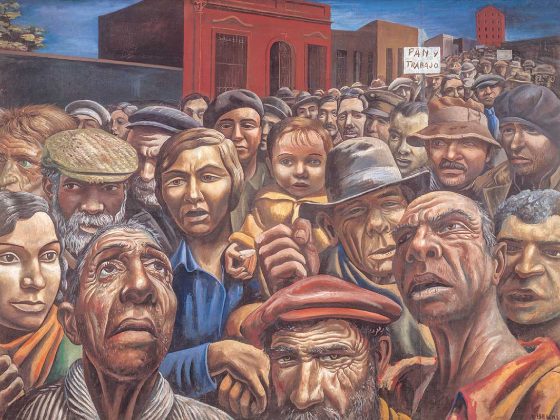
As part of the museum's twentieth anniversary celebrations and forty years after the death of Antonio Berni (Rosario, May 14, 1905 – Buenos Aires, October 13, 1981), Malba presents “Demonstration In Focus”, an online project paying tribute to Demonstration (1934), one of the artist's most emblematic works and a centerpiece of 20th-century Argentine art, belonging to the Malba Collection.
The project proposes a dialogue between past and present through in-depth research into the material, historical, and cultural aspects of the work. It is a joint initiative of the museum's Communication, Curatorial, and Conservation departments, in collaboration with the Tarea Center of the School of Art and Heritage (EAyP) of the National University of San Martín, to carry out a series of scientific and technical studies never before applied to this work.
The progress and results of this research will be compiled and published periodically on the website, with the aim of producing comprehensive content about the work, its author, and its impact on Argentine culture, aimed at both the general public and specialists.
"Demonstration shows his social commitment, which was particularly stirred by the arrival of David Alfaro Siqueiros in Argentina. It also presents Berni very well, who had been experimenting with surrealism and who took up political activism, exalting the workers' rally, expressed in those faces in the foreground derived from photographs that appeared in the press," explains María Amalia Garcia, chief curator at Malba. “The study of this piece in multiple directions will not only allow us to learn about previously unknown aspects of its materiality and pictorial procedures, but also to circulate knowledge and ideas about the artist and the work that are currently limited to debate among specialists,” she points out.
The website includes a Chronology of Berni's life, his work, and relevant events in Argentine history; an Archive containing documentary material about the piece and its context: period photographs, correspondence, and publications; a series of contemporary Testimonials from different disciplines that make up the multiplicity of voices in the Berni universe; Correlatos with a selection of works that dialogue directly with Demonstration; and Taller, a section that periodically compiles the progress of the material study of the work carried out by the Malba conservation team led by Alejandro Bustillo and coordinated by Florencia Gear, in collaboration with the Centro Tarea.
"Today, Demonstration invites us to take on new challenges in understanding the material aspects involved in this artist's poetics and symbolism. Throughout his work—and particularly in his later collages and assemblages —Antonio Berni paid particular attention to his materials and made wise use of their sensitive implications, in his pursuit of an avant-garde language that was at once accessible and understandable to those workers and people excluded from the capitalist system, to whose cause he was always militantly committed," explains Laura Malosetti Costa, Dean of the School of Art and Heritage at UNSAM.
Antonio Berni is one of the Argentine artists best represented in the Malba Collection with eleven pieces from all his periods. Over the past twenty years, the museum has dedicated two major exhibitions to him, which are among the most popular exhibitions in its history: Berni y sus contemporáneos (2005), curated by Adriana Lauria, with 115,000 visitors, and Juanito y Ramona (2014), curated by Marcelo Pacheco and Mari Carmen Ramírez, with 150,000 visitors.
About Demonstration
Demonstration (1934) is one of the seminal works of Nuevo Realismo, the artistic program that Berni conceived during those years, based on the conviction that artists and their work should maintain a close connection with historical and social processes. The characters in Manifestation are at a rally watching a speaker who is offstage and presumably located higher than the crowd. Berni arranges a large number of figures in the foreground, with others in the background. However, this is not an undifferentiated mass, as each component of the ensemble—a group of strikers who have come to a rally carrying signs—exhibits features and attitudes that make it unique.
This is one of the works that most fully expresses the influence of Mexican muralist David Alfaro Siqueiros—who visited Argentina in 1933—such as the use of large formats and photographic sketches to create a mass painting. It also expresses the reformulations that Berni imposed on the radicalized and exclusive approach to mural art: the replacement of large exterior walls with enormous burlap supports and the substitution of complex technological paraphernalia with the ancient technique of tempera painting. In this way, Berni constructed a transportable mural painting suitable for his time, capable of being displayed in factories and unions, large meetings, and situations of conflict.
About Antonio Berni
He was born in 1905 in Rosario, Argentina. He received his first drawing lessons in a stained glass workshop, and later with Eugenio Fornells and Enrique Munné. In 1925, he obtained a scholarship to study in Europe, where he attended courses taught by André Lhote and Othon Friesz. In 1934, he founded the Mutualidad Popular de Estudiantes y Artistas Plásticos de Rosario (Rosario Mutual Aid Society for Students and Visual Artists), where the ideology of New Realism was discussed and developed. He devoted himself to painting, passing through surrealism and social realism, and through the incorporation of collage and assemblage he arrived at three-dimensional material constructions such as the series Los monstruos, made with discarded objects. He created the “xilo-collage-relief” engraving technique and the figures of Juanito Laguna and Ramona Montiel. He died in 1981 in Buenos Aires.


