09.11.2015 — 02.08.2016
How Federico Manuel Peralta Ramos predicted the Internet with an egg
Curator: Chus Martínez
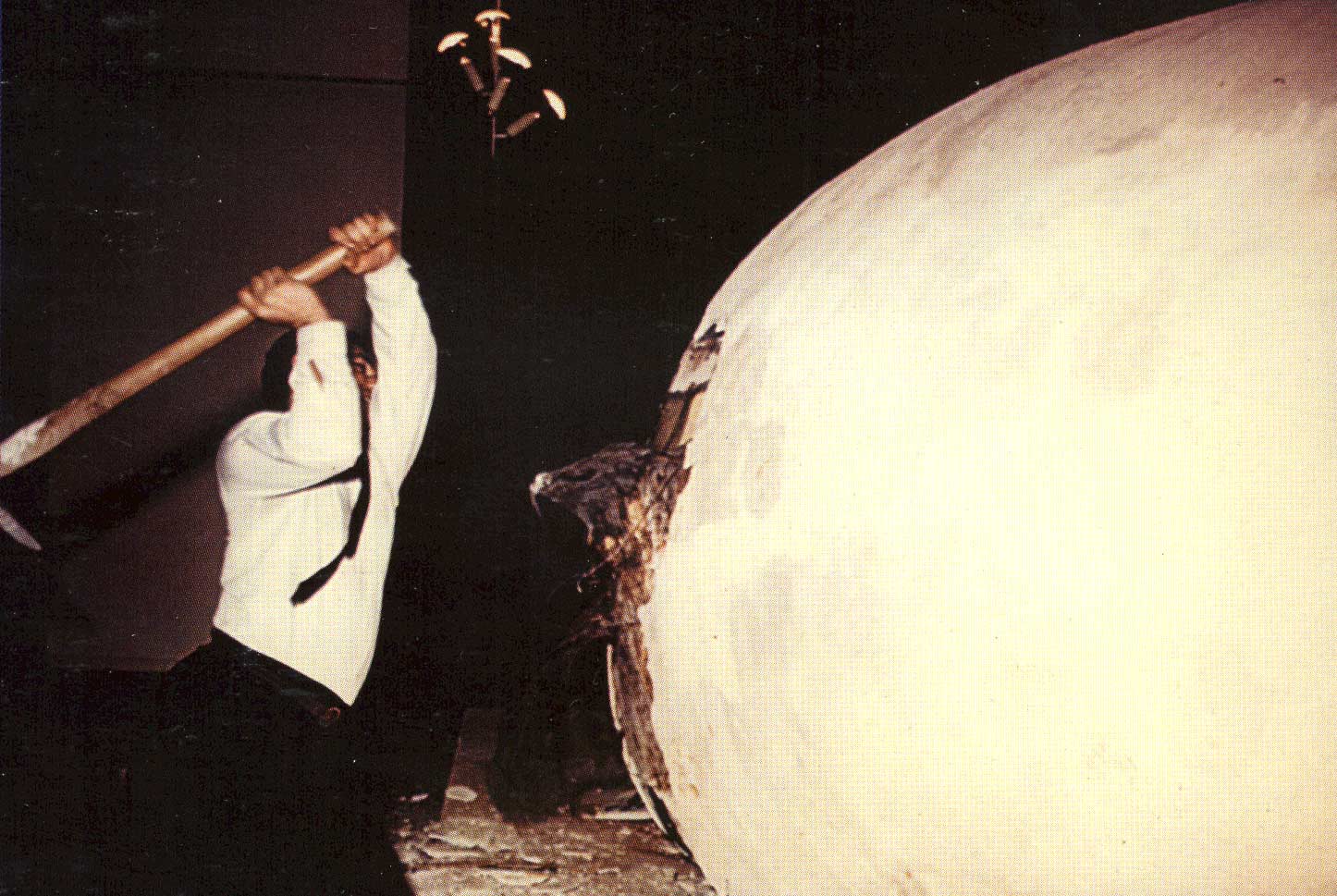
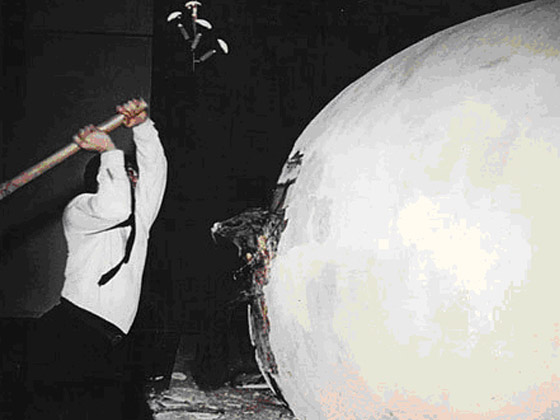
The exhibition revolves around ideas as delirious as linking Nosotros afuera [We, The Outsiders], a work by Federico Manuel Peralta Ramos, and research by Douglas Engelbart, the father of the hyperlink.
At around the same time—the mid-sixties—both grasped the problem of the straight line. There is no beginning or end to a sentence to give the words order or meaning.
Like the hyperlink, the egg is a symbolic monument to the end of all straight lines, an elliptical form that contains all sorts of curved energies in constant motion and generates an array of connectivities between organic, symbolic, aesthetic, and semantic matter: the origin of life, a new life with a new logic. The egg and the hyperlink belong to the same family. Both announce a different way of surfing the meaning of things.
Curator Chus Martínez says: “I use the term 'Metabolic Age' to refer to this new type of link fundamental to a century that is just getting underway Fond as we are of temporal territoriality, this new period comes after modernity. This small show announces its advent. We don’t need anything else. What matters is to do it here, in Argentina, in the innermost space of MALBA, and at the hand of the most naïve and visionary of all artists. A set of works—mostly videos—rallied by a new aesthetic-epistemological innocence will be exhibited. The mission of these works is to convince us that we must begin to educate ourselves, no longer in the critical exercise but, rather, in the purposeful abundance of ideas and worlds. That is the now of tomorrow.”
The Metabolic Age is the second chapter of Chus Martínez's research. The first was presented at e-flux in New York as We, The Outsiders from September 5 to November 1, 2014, and included the film Markeneier [Huevos de Marca] (1967) by German filmmaker Lutz Mommartz; a travel journal to the core of a volcano by Argentine artist Eduardo Navarro; and works by Polish painter Agnieszka Brzeżańska, among other projects.
Artists
Federico Manuel Peralta Ramos
(Mar del Plata, 1939 – Buenos Aires, 1992)
William Wegman (Holyoke, Massachusetts, 1943)
Eduardo Navarro (Buenos Aires, 1979)
Takeshi Murata (Chicago, 1974)
Jon Rafman (Montreal, 1981)
Petra Cortright (Santa Barbara, California, 1986)
Marcelo Galindo (Buenos Aires, 1973)
Wilfredo Prieto (Sancti-Spiritus, Cuba, 1978)
Chus Martinez' Introduction
It seems impossible to justify using Peralta Ramos‘s "egg" to explain the birth of the Internet and the new media. "Egg" is my personal nickname for a work that has been close to me for a number of years. Produced in 1965 in the context of an exhibition at the Instituto Torcuato Di Tella, the work is considered the outer boundary of Federico Manuel Peralta Ramos’s career –even if that is not really true and he continued to produce work afterwards.
But our interest in "reality" is partial, which is why I can say that, for me, this work is the beginning of the Internet. Yes, that’s exactly what I mean, don’t get me wrong. The egg –symbol par excellence of the possibility of a private language in the Victorian age (Humpty Dumpty)– is as much the container of all (genetic) information required by life as it is the herald of a new beginning. That is why the world outside the egg is a kind of digital mermaid, half cybernetics and half idiocy. That media-idiocy mix is one of the greatest achievements of art from the second half of the 20th century and into the present.
Regardless, you will certainly think that I am distorting reality, but that process of distortion is precisely what defines research in art. Distorting artistic, aesthetic, informative, linguistic, social, and material languages is something art does ceaselessly, without making any fuss, even though it has enormous impact on the transformation of our senses, of our way of perceiving and, therefore, of thinking. This "distortion" is organic, not formal.
That is why I speak of a metabolic age, a time –our time– when modern ways of ordering time and its production are becoming a thing of the past as we delve into a world where changes ensue in an osmotic, rather than a conscious, fashion. A world marked by a sense of absorption that will bring an end to dual systems like before/after, center/periphery, man/woman, human /natural, etc...
Are we ready? Our guide is the egg, and this is my personal homage to one who, very early on, understood that we will change through contact, not through consciousness.
Trailer
Micro-site
As part of the exhibition, MALBA developed a special microsite accessible at laerametabolica.malba.org.ar. The site expands on Chus Martinez's curatorial thesis with various essays on the metabolic era, theoretical materials, and references to artists and thinkers featured in her research. It also includes profiles of each of the artists and their works in the exhibition.
It is organized in the form of a map that graphically shows the relationship between Peralta Ramos' egg and the hyperlink, through the incorporation of keywords that are updated in real time with each search. The site will grow, “metabolizing information,” over the course of the exhibition.

Chus Martínez
Born in Spain, she studied philosophy and art history. She is currently Director of the Institute of Art at the FHNW Academy of Arts and Design in Basel, Switzerland. Previously, she was Chief Curator at El Museo del Barrio in New York. She was Head of Department and a member of the Core Agent Group for dOCUMENTA (13) in 2012. Before that, she was Chief Curator at MACBA, Barcelona (2008–2011), Director of the Frankfurter Kunstverein (2005–08), and Artistic Director of Sala Rekalde, Bilbao (2002–05). For the Venice Biennale, she curated the Pavilions of Catalonia (2015, together with Albert Serra) and Cyprus (2005). Last year she was also Curatorial Advisor for the Istanbul Biennial. In 2008, Martínez served as Curatorial Advisor for Carnegie International and in 2010 for the 29th São Paulo Biennial. She was also the founder of the Deutsche Börse Residency Program for international artists, art writers, and curators. During her tenure as Director of the Frankfurter Kunstverein, she curated the solo exhibition of Wilhelm Sasnal, among others, and a series of group exhibitions including Pensée Sauvage and The Great Game To Come. At MACBA, Martínez curated the Thomas Bayrle retrospective, a monographic exhibition of the Otolith Group, and an exhibition dedicated to television: Are you ready for TV? In 2008, Martínez was the curator of The Unanimous Life, the retrospective exhibition of Deimantas Narkevicius at the Reina Sofía Museum of Art in Madrid, which traveled to major European museums.
In the Press
Reconstruyen el huevo de cemento que entró en la historia del arte
Clarín, 09.09.2015
Al Malba, en recuerdo del maravilloso Federico Peralta Ramos
La Razón, 22.10.2015
El huevo y la gallina
Página 12, 27.09.2015