Event Details
This event finished on 29 February 2016
- Categories: Exhibitions
- Tags: Plantilla histórica
09.20.2015 — 03.01.2016
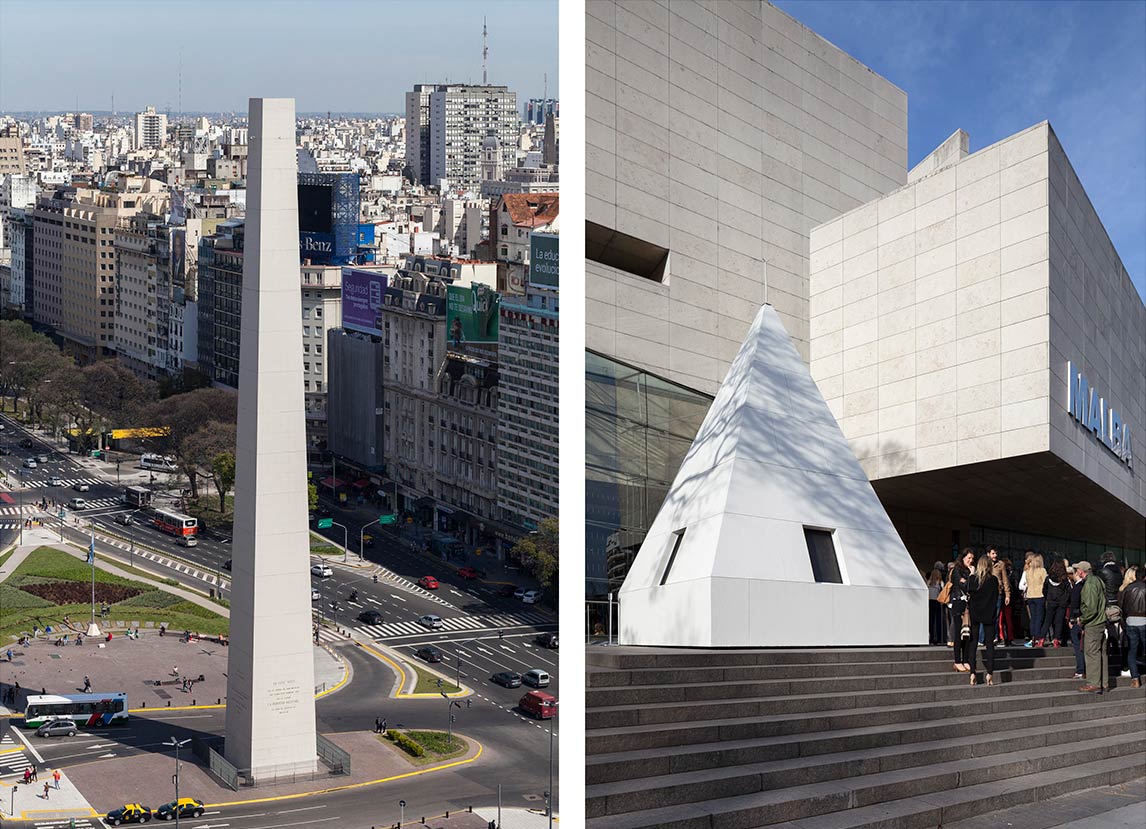
Leandro Erlich's (Buenos Aires, 1973) first site-specific work in our country, which takes the Obelisk of Buenos Aires—an icon of the city—as the central axis of a monumental public art project.
Through his artistic intervention, Leandro Erlich—one of Argentina's most internationally renowned artists—offers visitors the chance to explore the interior and discover its aerial view for the first time since its founding in 1936.
“I am interested in creating projects in which art escapes the confines of conventional exhibition centers and becomes interwoven with everyday life,” explains Erlich. "I am interested in art as a tool for integration, action, and connection. The relationship between cities and monuments and what it means to visit them, because it's not just tourists who do so; it has to do with appropriation, pride, belonging. And the Obelisk in Argentina is a monument that was never intended to be visited," he adds.
La democracia del símbolo (The Democracy of the Symbol) is a unique artistic and social initiative, the result of collaboration between the artist and his studio, MALBA, the Government of the City of Buenos Aires, and Fate, the largest tire manufacturer in the country.
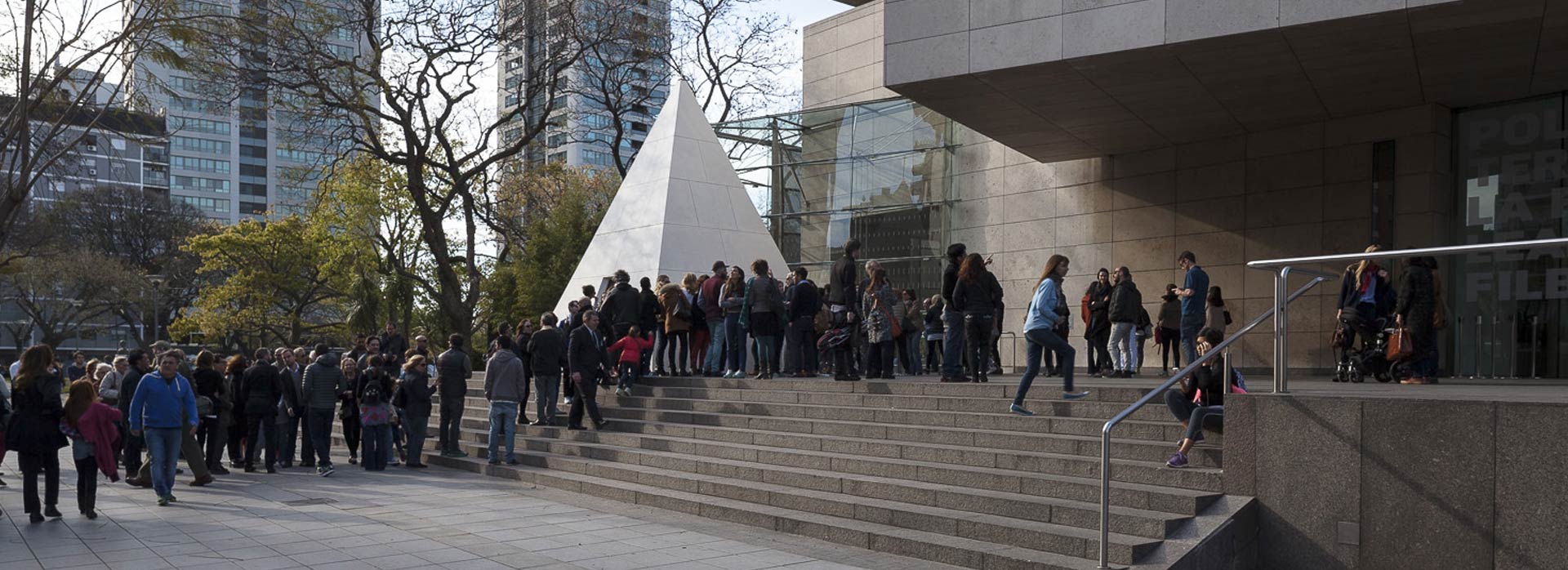
The work consists of two parts. On the one hand, at the Obelisk site, the artist directly intervenes on the monument, making its apex disappear, which reappears on the MALBA esplanade with a full-scale reproduction. In this way, the public will be able to enter the summit, with free admission, and enjoy the four aerial views of the central monument in the Argentine imagination.
The Obelisk was built in 1936 by modernist architect Alberto Prebisch. Since then, it has been a meeting place for celebrations and popular demonstrations. It has also inspired countless artistic projects by pioneering photographers such as Grete Stern and Horacio Coppola—who recorded its construction in a film—Marta Minujín, and Leandro Katz, among many others.
Its interior up there always aroused everyone's curiosity, and this project offers for the first time the possibility of democratizing access to it, transforming it into a public monument, open to all.
Leandro Erlich
He was born in Buenos Aires, Argentina, in 1973. He has lived in the US and France. He currently works between Buenos Aires and Montevideo. He received grants from the FNA (1992) and the Antorchas Foundation (1994-95). He has participated in dozens of solo and group exhibitions in Argentina and abroad: Sean Kelly Gallery (USA, 2011), Luciana Brito Gallery (Brazil, 2009 and 2013), XXI Century Museum of Contemporary Art (Kanazawa, Japan, 2014), Museo Reina Sofía (Spain, 2008), PS1-MoMA (USA, 2008), Galería Ruth Benzacar (Argentina, 2000, 2007, and 2012), Fundación Proa (Argentina, 2009 and 2013), Centre Pompidou (France, 2011 and 2012), SongEun Art space (Korea, 2012), Izolyatsia (Ukraine, 2012), among others. His works are in private and public collections such as the Tate Modern (London), the Centre Pompidou, the Israel Museum (Jerusalem), and the XXI Century Museum of Contemporary Art (Kanazawa, Japan). He has participated in the biennials of Montevideo (Uruguay), São Paulo (Brazil), Shanghai (China), Echigo-Tsumari (Japan), Havana (Cuba), Istanbul (Turkey), and Whitney (USA), among others. He represented Argentina at the Venice Biennale (2001). He received the Joan Mitchell Foundation Award (2001), the UNESCO-Istanbul Biennial Award (2001), and the Leonardo Award (MNBA, 2000), as well as the Konex Award (2002 and 2012).
Erlich and the Obelisk
Leandro Erlich has been working with the Obelisk of Buenos Aires since the early years of his career. In 1994, he presented a project to install a metal obelisk in the La Boca neighborhood, which would be an exact replica of the original (it would retain the dimensions and height of 67.5 meters) but built on an iron structure and covered with steel sheets.
In Erlich's words: "The game was to imagine a city in which there was no monument with the iconic uniqueness of what the Obelisk represents for the City of Buenos Aires, but rather to create a double for it. I was interested in that duplicity—it was quite provocative because the Obelisk has always been a geographical reference point, a landmark—; imagining meeting someone at the Obelisk, for example, and then being asked, “Which one?” seemed interesting to me. It had to do with an idea linked to decentralization."
That project had the support of the Antorchas Foundation, the approval of local residents, and was accepted by municipal authorities, but in the end it never came to fruition. La democracia del símbolo brings the artist's 20-year obsession full circle.
"Obelisks and pyramids, among other formidable monuments, have been timeless, hypnotic, concentric emblems since ancient times. Colossal, hermetic, and indestructible. This is how they have been imagined, revered, and feared. (...) Our political imagination has tended to be, almost always, vertical, and will continue to be so, at least as long as it imagines, reveres, and fears with its gaze absorbed upward. And yet, these symbols remain firm and resounding as long as they are believed in. If we did not, their supremacy—that peculiar space stretched between the sacred, the fearsome, the erotic, and the inaccessible—would collapse in a matter of moments. It is a matter of finding out—through sacrilege—what is inside. Perhaps there is nothing, nothing more than what their idolaters place in them. And that is why they symbolize, at the same time, everything and nothing," writes Argentine sociologist Christian Ferrer in the book that accompanies the project.
Video recording
In the Press
La pregunta que se hacen todos: «¿Qué pasó con la punta del Obelisco?»
Clarín, 20.09.2015
Sorpresa: una obra de arte «rebana» la punta del Obelisco
Clarín, 20.09.2015
La punta del obelisco ahora queda en Malba
La Nación