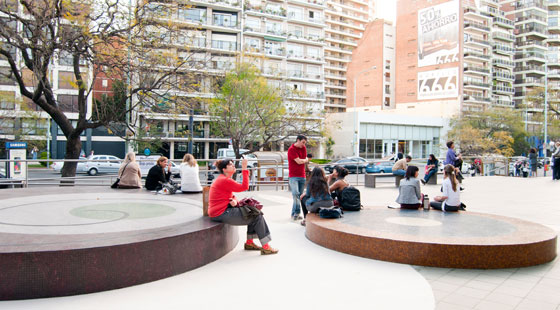
Esplanade
Project: Nushi Muntaabski and Cristina Schiavi.
Production and direction: Nushi Muntaabski
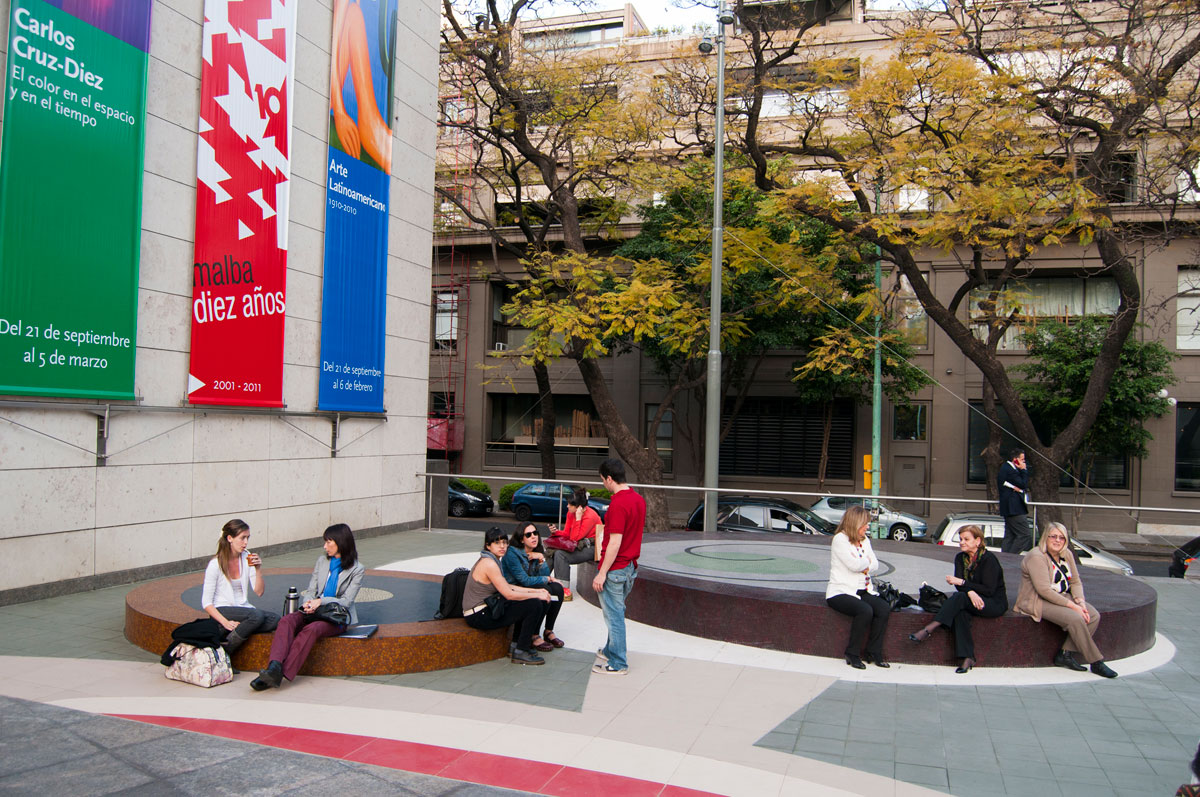
Since September 2011, Malba has been exhibiting the work Homenagem by Nushi Muntaabski (Buenos Aires, 1963) and Cristina Schiavi (Buenos Aires, 1954) on its esplanade: a dry plaza inspired by Roberto Burle Marx's landscape design for the Plaza República del Perú, adjacent to the museum building.
Homenagem was conceived as a space for museum visitors to meet, relax, and enjoy themselves, as well as a gift to be contemplated from above. “Today, Malba is a symbol of the city, a place that embodies the idea of leisure, culture, and pleasure,” says Nushi Muntaabski. The artist lived across from Plaza República del Perú from the ages of 6 to 14, and her own history and that of the neighborhood were the catalysts for the project, which was incorporated into the museum's permanent collection.
"My siblings, my parents, and I really enjoyed the plaza. We would spend the whole day there after school, riding our bikes around the spiral, sliding down what we called ‘batitubos’—wonderful cylindrical shapes that helped us practice our balance and agility. The good thing was that we were protected there, and my parents watched us play from the balconies," she recalls.
To work on the design of this space, measuring approximately 160m2, Muntaabski called on the artist Cristina Schiavi: "We share a love for Burle Marx. We had many meetings drawing in my studio, at her home, looking at photos of landscapes, sidewalks, and building terraces created by the Brazilian artist, to get closer to the aesthetics and lines of his landscapes."
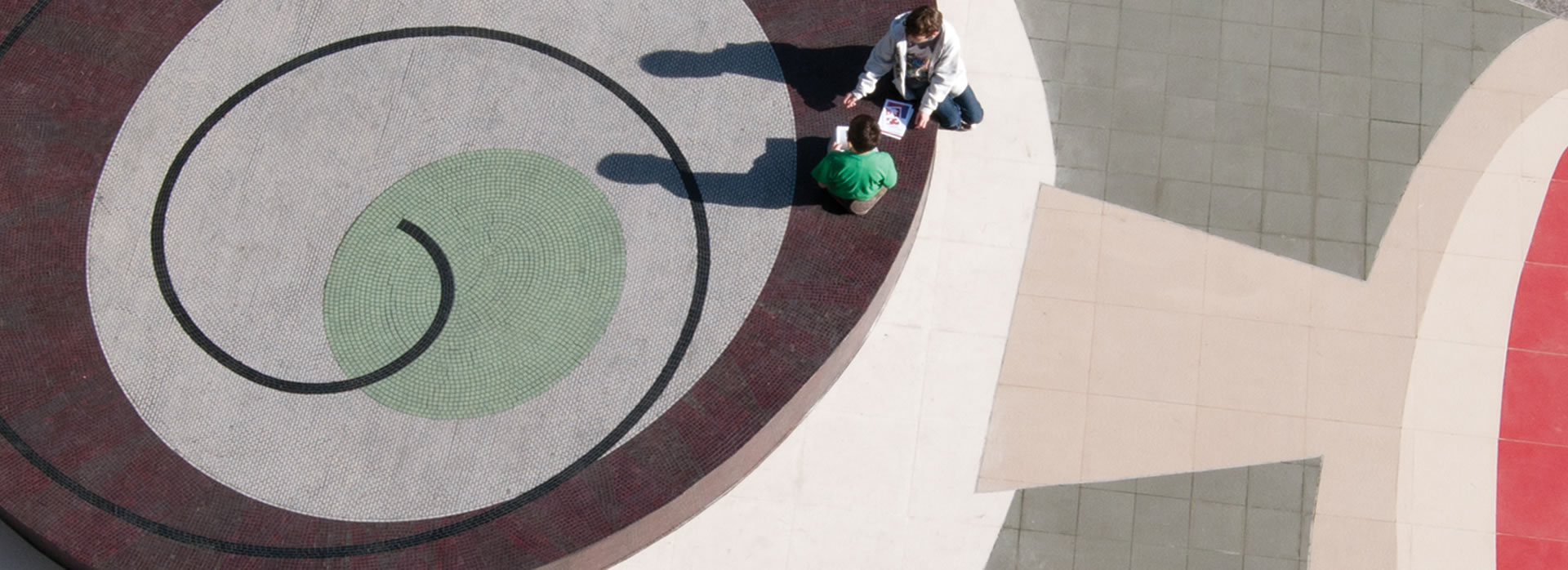
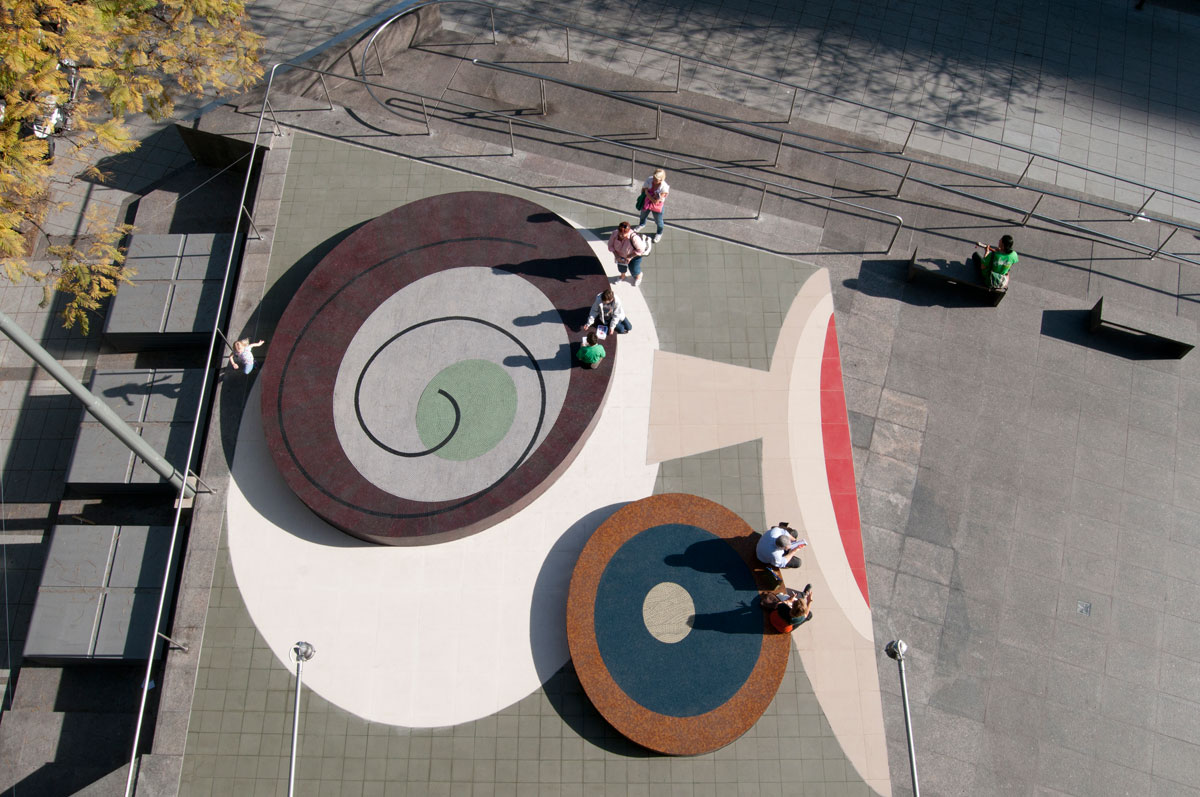
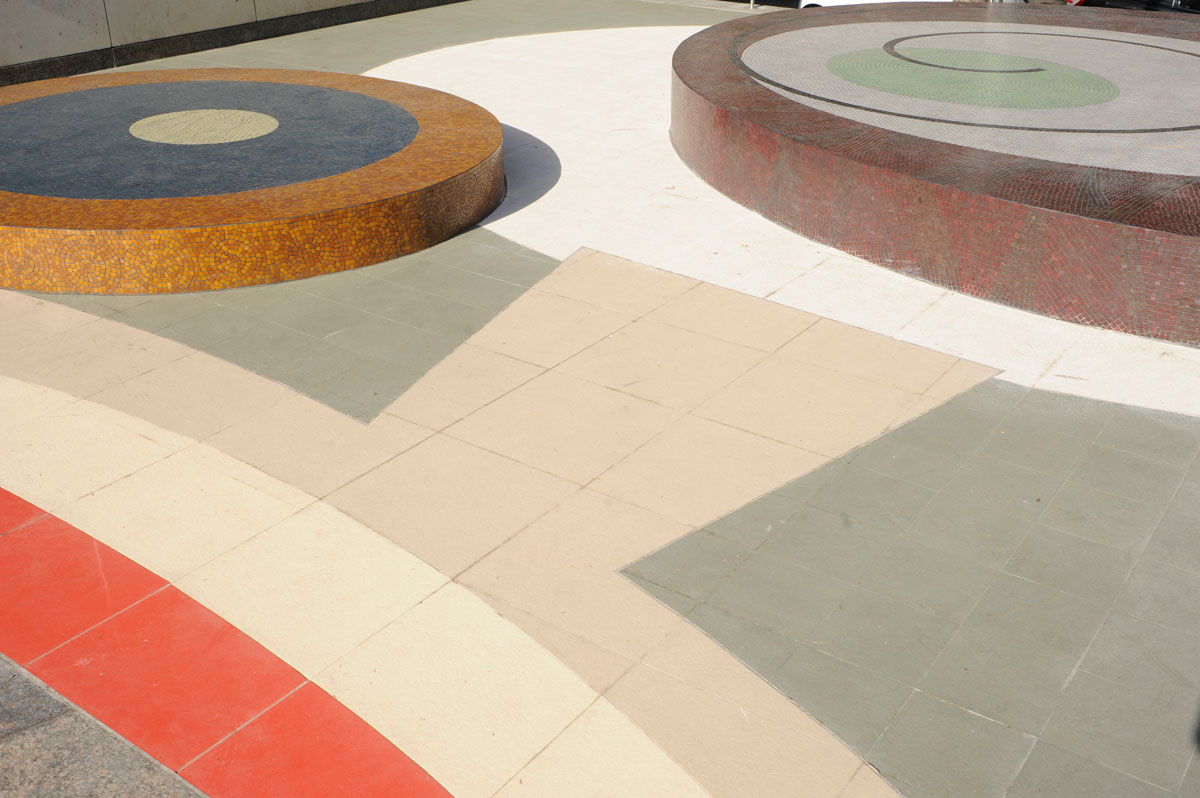
Based on a large concrete spiral—demolished in 1995—and the circle where the statue of Inca Garcilaso de la Vega stands, Homenagem consists of two circles that rise 30 and 45 cm above the surface, respectively, covered with Venetian mosaic, a central material in Nushi's production. “I thought of mosaic because it combines utility and beauty: it has many properties, such as moisture insulation and color durability, and it is in keeping with the predominant aesthetic of the neighborhood, which was developed architecturally in the 1950s and 1960s,” explains the artist.
Like Burle Marx, who worked with indigenous elements, Muntaabski ensured that all the materials used were sourced from domestic industry. She also recaptured the spirit of the author's various works: the design of the space can be best appreciated from above, both from the museum's front terrace and from the balconies overlooking Figueroa Alcorta Avenue. The intertwined colors directly refer to the range used by Burle Marx and blend naturally into the museum's façade.
Nushi Muntaabski
Born in Buenos Aires in 1963, he works in various disciplines: objects, video, painting, performance, photography, and installations. In 2004 and 2005, he edited the art magazine Canecalón. Since 2005, she has directed the project Las Piedras Preciosas (Precious Stones), where she integrates her artistic work with architecture, creating murals, site-specific works, and other commissioned pieces for collectors, architects, and industrial designers. Since 2008, she has participated in Tarde Negra, a radio program on Rock and Pop, with an art column.
Among other distinctions, she received a scholarship from the Antorchas Foundation for the 2001/2002 scenic experimentation workshop, an honorable mention in the “Premio Limbo” award, MAMBA 2003, and received a grant for the arts from the City of Buenos Aires Culture Fund in 2005 and first prize from the Federico Klemm Foundation in 2010. Some exhibitions: Regreso al Paraíso (Return to Paradise), ITAU Foundation, 2011, Taxidermia (Taxidermy) (objects), Vasari Gallery, 2010. Mercado (installation), Malba Museum, 2008, Rancho aparte (installation), CCEBA 2001, Últimas tendencias, Museum of Modern Art of Buenos Aires 2002, ARCO, Luisa Pedrouzo Gallery, Madrid 2002, El beso (The Kiss), Doque Gallery, Barcelona 2003, Vértigo (Cubo de Nieve) (Vertigo (Snow Cube)), Malba Museum 2004, Azcue, art space 2005, Macro Collection, Recoleta Cultural Center 2006.
Cristina Schiavi
She was born in Buenos Aires in 1954. She studied architecture at the Faculty of Architecture and Design of the University of Buenos Aires. In the early 1980s, he studied painting with Jorge Demirjián and Aurelio Macchi. In 1987, she held his first solo exhibition. In 2001, she received a Visual Arts Grant from the National Arts Fund, and between 2004 and 2005, she participated in residencies in Mallorca and Taiwan. In 2003, she participated in the Intervention Program with the work La toma, and in 2009, she organized the exhibition Contemporáneo 23. Mercado, both at Malba. She won First Prize for Acquisition at the Bahía Blanca Biennial (1999) and First Prize at Prodaltec for Digital Art (2000). Between 2004 and 2008, he coordinated, together with Tamara Stuby and Esteban Álvarez, the El Basilisco project, a residency program for artists, of which they are founders and managers. She lives and works in Buenos Aires.
Production team
Director: Nushi Muntaabski
Producer: Tuny Schvindt
Team leader: Agustín Lupo
Team: Stella Blanchart, Sergio Enriquez, Vanesa Márquez, Cecilia Racciatti, Eliana Scheave
Burle Marx and the Republic of Peru Square
Landscape architect, architect, and visual artist Roberto Burle Marx (1909–1994), born in São Paulo, Brazil, designed the Plaza República del Perú in 1972, located between Martín Coronado, Jerónimo Salguero, and Figueroa Alcorta avenues in Buenos Aires. It was a structure consisting of a concrete spiral that served as both a rest area and a playground for children, connected to another circle where the statue of Inca Garcilaso de la Vega (which still stands today) was located. Responsible for many of the most important works in Rio de Janeiro—including the characteristic Copacabana Promenade—and other cities around the world, Burle Marx worked with native plant species, which he also incorporated into the design of this plaza. In 1995, his only work in Argentina was demolished by the city government, in a case unique in the world. Six years later, Malba was inaugurated on the same block where the square is located.