Event Details
This event finished on 23 October 2020
- Categories: Exhibitions
- Tags: Plantilla histórica
09.21 — 10.23.20
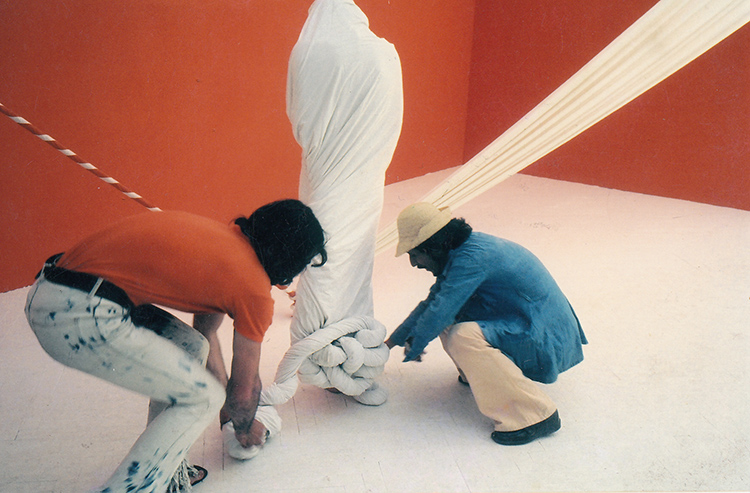
The opening chapter of History as Rumor compiles archival material and oral history about a pioneering postmodern performance by Jorge Eduardo Eielson (Lima, 1924–Milan, 2006), one of the greatest Latin American poets and visual artists of the second half of the 20th century.
Based on the 1972 action El cuerpo de Giulia-no (247 metros de algodón crudo) (based on the novel published in Mexico in 1971), which was presented at the 36th Venice Biennale in 1972, the research highlights the place of the pre-Columbian quipu as a central element of her work and her pioneering exploration of the indigenous culture of the Andean region, as well as the notion of difference that proposes a fluid conception of gender, from the (un)tying of the fabric to the construction of a queer subjectivity.
Widely known in Latin America for his work as a poet belonging to the so-called Generation of 1950, Jorge Eduardo Eielson developed a complex body of work from his exile in Europe, in which he initiated an unprecedented dialogue with aspects of pre-Columbian Peruvian culture.
Curators: Gabriela Rangel y Sharon Lerner.
Witnesses: Martha Canfield, Alberto y Gianni Buscaglia.
Rumors: Cecilia Pardo, Mariela Dreyfuss, Rodrigo Vera y Miguel López.
Institutional Colaborators: Museo de Arte de Lima (MALI) y Centro de Studi Jorge Eduardo Eielson.
History as Rumor
Multiple movement performances
On the occasion of the celebration of its nineteenth anniversary, Malba presents La historia como rumor (History as Rumor), an annual program of online exhibitions created by Gabriela Rangel, Malba’s artistic director, with the aim of documenting and contextualizing a set of performances that took place at different times and in various places in the Americas and the Caribbean, in a historical transition period marked by the end of the Cold War and the advent of the internet.
A collaboration between guest curators and various international museums and institutions is the starting point to present a research project every month that will allow us to revisit a series of actions and performances that became production milestones of their time, and that will engage in a direct or indirect conversation with problem areas of the present. A video record of testimonies from spectators who witnessed those performances, and of experts from different disciplines giving their opinion on them, will create an archive that will make up the oral history for each of the projects.
The selection of artists and specific actions respond to a very broad framework that began to be debated regionally in 1981, at the First Latin American Colloquium on Non-Objectual Art and Urban Art at the Museum of Modern Art in Medellin, Colombia. The starting point of the selection also understands the historical transmission of performances as a rumor, defined as a multiple movement in a diagram sketched by Ulises Carrión, Mexican poet and visual artist based in Amsterdam. Both frameworks propose the reconfiguration of a set of works in a period of time influenced by the conceptualisms that began globally since the 1960s.
The exhibition of each performance includes a record of the action, along with vast archival material, such as photographs, films, storyboards, press clippings and documents that aid the reconstruction of the piece and its context. It also includes an interview with someone who has witnessed the performance and four video testimonies by leading specialists from different disciplines. The choice of the various voices and materials is intended to recontextualize these performances in the present as contemporary expressions.
The series La historia como rumor will be available until September 21st, 2021 along with Malba’s 20th Anniversary celebration.
About El cuerpo de Giulia-no
Countless performances and actions throughout the history of this hybrid medium lack adequate documentation that would allow them to be reconstructed exhaustively in the present. Such has been the case with many of Jorge Eielson's performance works, whose action El cuerpo de Giulia-no (247 metros de algodón crudo), presented at the 36th Venice Biennale in 1972, was photographically recorded by brothers Alberto and Gianni Buscaglia.
Although there are images of the action, there were no testimonies about the context of the piece that Gianni Buscaglia now offers, in addition to a letter and questionnaire sent by Eielson to the photographers in which he explains his strategies and poetics. Also added to the historical archive as rumor is the recording of Música de Ogando, a 1974 performance presented by Eielson in the Colleggio Cairoli cloister in Pavia, Italy, and recorded by the Buscaglia brothers.
The curators extended invitations to four Peruvian “rumoristas”: Cecilia Pardo, an archaeologist who is currently organizing a major exhibition of pre-Hispanic quipus; Mariela Dreyfus, a poet and academic based in New York; Rodrigo Vera, an art historian who studies Eielson's work; and Miguel López, a cultural critic focused on global feminist and queer poetics. Together, they propose a reading of the performance El cuerpo de Giulia-no (247 metros de algodón crudo) from the present and from the perspective of a dislocated imaginary community.
The witnesses in this unique performance, which marks the beginning of an exploration into fluid subjectivity, are Martha Canfield, poet and executor of Eielson's work, and Gianni Buscaglia, who offers a written account of his relationship with the poet.