

03.19 — 08.16.21
The exhibition Terapia (Therapy) takes its cue from the influence of therapeutic discourse and practices in the psychoanalytic arena in Argentine culture, together with the reception of Freudian theory in Europe and the United States at the beginning of the last century.
The process of reception and institutionalization of psychoanalysis in Argentina allowed the passage from the hospital to the clinician’s office, from the unionized APA (Argentine Psychoanalytic Association) to the classroom, and, finally, it opened up to the assimilation into popular visual culture through mass-circulation magazines, especially in the capital city and other urban centers.
The psychoanalytic discourse, as well as its practice, exerts a remarkable influence on the local arts and culture, so much so that Argentina is said to be perhaps the only place in the world where psychoanalysis still retains intellectual property rights as a social force and an individual commitment.
The exhibition organized by Malba stems from the influence this important field of practice-knowledge has had and still has, which has become embedded in the national identity, and exhibits a selection of works by Argentine modern and contemporary artists who converse with different aspects, subjects, and issues of this discipline.
Works by Juan Batlle Planas, Grete Stern, Emilio Renart, Aída Carballo, Mildred Burton, Emilia Gutiérrez, Luis F. Noé, Martha Peluffo, Ideal Sánchez, Lea Lublin, Narcisa Hirsch, Oscar Masotta, Susana Rodríguez, Grupo de los Trece, Stephanie Argerich, Marisa Rubio, Claudia del Río, Nicolás Guagnini, among many others, will be exhibited along with a condensed selection of documental pieces relevant to the development of this field of studies in relation to arts and culture.
Curators: Gabriela Rangel, Verónica Rossi y Santiago Villanueva.
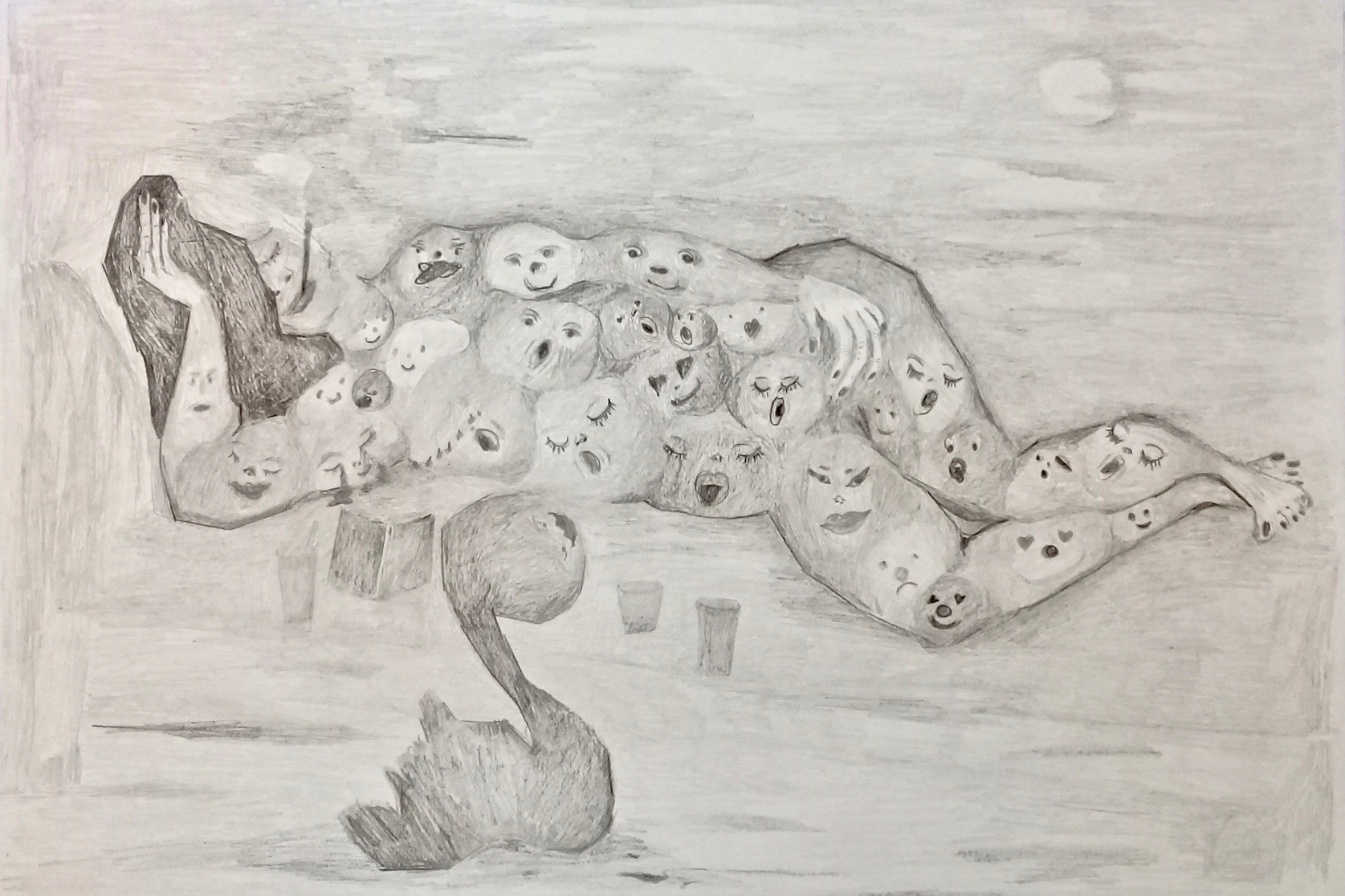
Images: Emilia Gutiérrez. El descanso. Oil on canvas. 70 x 90cm. Familia Traba's Collection / Claudia del Río. Claroscuro latinoamericano, 2020. Pencil on paper. 34,5 x 50 cm.
Catalogue
A catalog that includes the reproduction of the works and documents, as well as the commissioning of unpublished texts will be published in due time.

Magazine
In addition to the exhibition catalog, Malba published a magazine that presents four experiences related to psychoanalytic practice through testimonials and documents.
The materials selected for this publication include: an important passage from the famous interview between the legendary founding member of the APA, Enrique Pichon-Rivière, and the writer Vicente Zito Lema; the fictionalization of a therapeutic situation by the contemporary artist Marisa Rubio through the heteronym Naranja Milano Questa; a logbook of the unconscious and everyday musings written by painter Martha Peluffo; and a conversation about the disappearance of the space of masculine power between New York-based Argentine artist Nicolás Guagnini and art historian, critic, and curator David Joselit.
Psychoanalysis in Argentina
The discipline created by Sigmund Freud in Vienna around 1896 arrived in Buenos Aires from Europe at the beginning of the 20th century, following discussions among psychologists, psychiatrists, doctors, and philosophers about mental health practices. In a short time, it managed to penetrate the language used in the urban fabric of the capital and the country's main cities, as well as being incorporated into academic study programs.
As a method of therapy or healing technique, psychoanalysis achieved great popularity in the 1930s in popular magazines and later in the mass media, becoming, according to historian Mariano Plotkin, an object of cultural consumption.
In 1942, the Argentine Psychoanalytic Association (APA) was founded by a group of six members, some of whom had emigrated from Europe: Celes Cárcamo, Enrique Ferrari Hardoy, Ángel Garma, Marie Langer, Enrique Pichon-Rivière, and Arnaldo Rascovsky. The exhibition includes portraits of the founders taken by photographers Annemarie Heinrich and Ricardo Sanguinetti, as well as extensive research on the origins of the institution.
The APA not only institutionalized psychoanalysis in the country, but was also the first space dedicated to the professional training of psychoanalysts in Latin America. It operated in sync with discussions among European and North American peers. Likewise, since 1943, the APA has produced the journal Psicoanálisis, the first publication in Spanish dedicated to the Freudian discipline. Throughout its history, the APA was shaken by successive fractures. Some of the founders, such as Langer and Pichon-Rivière, separated from it to take up positions in other areas of therapeutic practice, while others ceased to play an active role within its structure.
Enrique Pichon-Rivière was a key figure who exerted a great influence in different places and moments of the Argentine cultural scene: he belonged to Batlle Planas' surrealist circle, was close to writers Roberto Arlt, Enrique Molina, and Jacobo Fijman, wrote a biography of the Comte de Lautréamont, hosted the first exhibition of Concrete Art Invention in his home, and he introduced Oscar Masotta to the theories of Jacques Lacan.
In the 1960s, the APA's discourse expanded, and several of its figures came to occupy a prominent place in the programmatic content of experimental art centers such as the Instituto Torcuato Di Tella and later the Centro de Arte y Comunicación (CAYC). The research of Emilio Rodrigué and South African psychiatrist David Cooper (who visited the country repeatedly) is unavoidable in this period.


