23.11 — 23.12.20
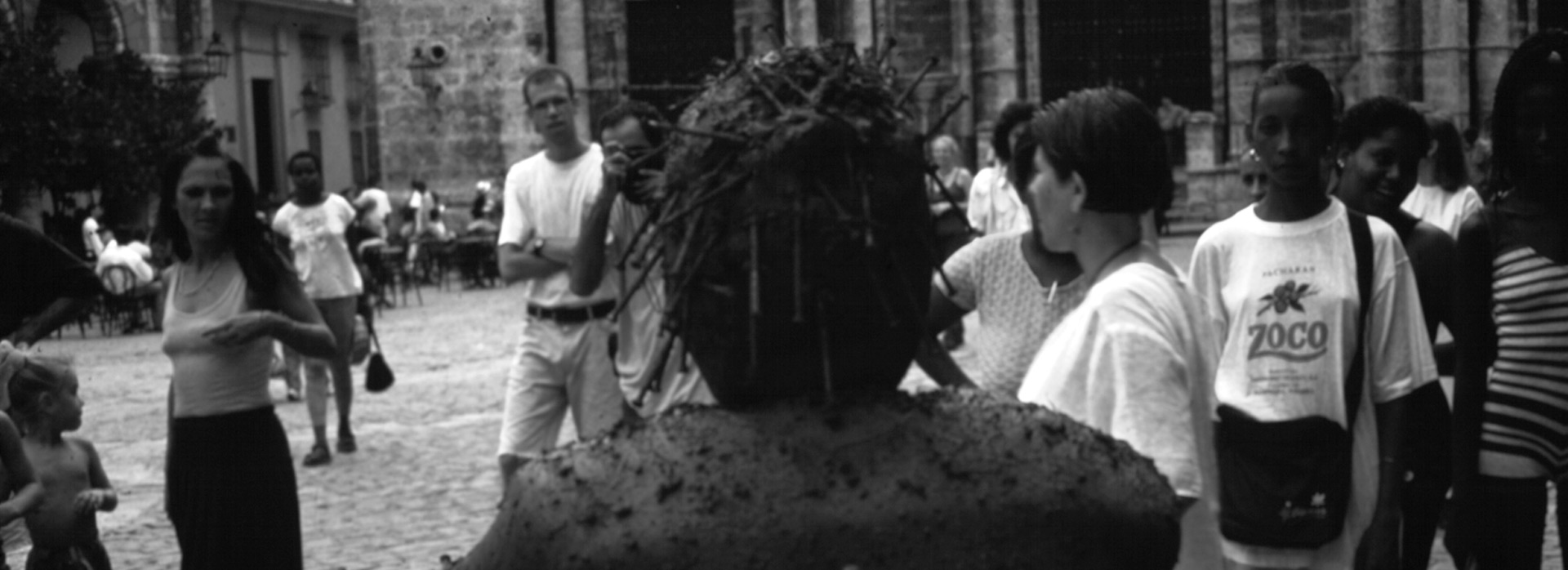
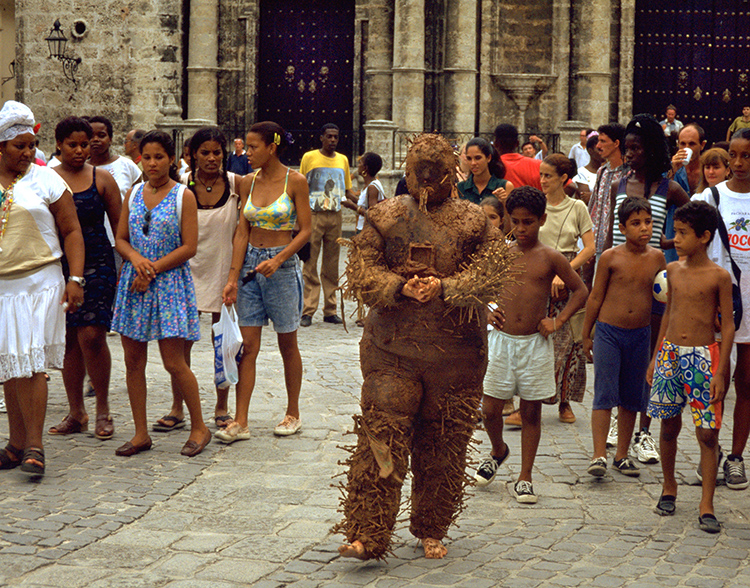
Third exhibition in the program “History as Rumor,” based on the performance Destierro that Tania Bruguera (Havana, 1968) staged in the streets of Havana. Initially conceived for the Bienal del Barro in Caracas in 1998 and later presented in Havana (1998-1999), Los Angeles (1999), and Philadelphia (2017), for this action the artist made a costume inspired by the Congolese fetish Nkisi Nkondi to walk around with it on her back.
An anthropomorphic figure pierced by nails and composed of earth and clay, whose function is punishment and reward, embodied in Bruguera's performance, the Nkisi marks the end of a cycle for the artist, dedicated to revisiting the relationship between the body and ritual, exile, and magical thinking, in which Ana Mendieta occupied a central place as a reference point for non-Western ritual practices interwoven with the vocabulary of the international neo-avant-garde art movement.
Although Bruguera dressed up as a fetish to walk the streets of Havana on Fidel's birthday, this act superimposes the knowledge of Cuba's historically most oppressed population, Afro-descendants, projecting it into a public sphere dominated by state surveillance and tourism. The Nkisi represents the unfulfilled aspirations of the revolution in its inveterate inability to bring about the longed-for social transformation and happiness for the dispossessed.
Data Sheet
Curator: Gabriela Rangel
Colaborator: Diego Sileo
Testimonial: Cristina Vives
Rumores: Sagrario Berti y Dulce Gómez, Lucía Sanromán, Claire Bishop y Matilde Sánchez
Institutional Colaborators: PAC, Padiglione d’Arte Contemporanea, Milán
Colección Patricia Phelps de Cisneros, Nueva York
Main support:

With the collaboration of:

History as Rumor
Multiple movement performances
On the occasion of the celebration of its nineteenth anniversary, Malba presents La historia como rumor (History as Rumor), an annual program of online exhibitions created by Gabriela Rangel, Malba’s artistic director, with the aim of documenting and contextualizing a set of performances that took place at different times and in various places in the Americas and the Caribbean, in a historical transition period marked by the end of the Cold War and the advent of the internet.
A collaboration between guest curators and various international museums and institutions is the starting point to present a research project every month that will allow us to revisit a series of actions and performances that became production milestones of their time, and that will engage in a direct or indirect conversation with problem areas of the present. A video record of testimonies from spectators who witnessed those performances, and of experts from different disciplines giving their opinion on them, will create an archive that will make up the oral history for each of the projects.
The selection of artists and specific actions respond to a very broad framework that began to be debated regionally in 1981, at the First Latin American Colloquium on Non-Objectual Art and Urban Art at the Museum of Modern Art in Medellin, Colombia. The starting point of the selection also understands the historical transmission of performances as a rumor, defined as a multiple movement in a diagram sketched by Ulises Carrión, Mexican poet and visual artist based in Amsterdam. Both frameworks propose the reconfiguration of a set of works in a period of time influenced by the conceptualisms that began globally since the 1960s.
The exhibition of each performance includes a record of the action, along with vast archival material, such as photographs, films, storyboards, press clippings and documents that aid the reconstruction of the piece and its context. It also includes an interview with someone who has witnessed the performance and four video testimonies by leading specialists from different disciplines. The choice of the various voices and materials is intended to recontextualize these performances in the present as contemporary expressions.
The series La historia como rumor will be available until September 21st, 2021 along with Malba’s 20th Anniversary celebration.
Expulsion and exile
Destierro marks an important transition in Bruguera's career, which took a new direction after she completed a series of remakes of Ana Mendieta's performances, grouped under the title Homenaje a Ana Mendieta (Tribute to Ana Mendieta). A dazzling and tragic figure of the Cuban exile community in the US, Mendieta was rediscovered by Cuban critics and artists in the 1980s, following her trip to the island a few years before her death in 1985.
The name of the piece, Destierro, reveals its metaphorical relationship with the departure of many Cuban artists during those years that comprise the so-called “Cuban Special Period.” Bruguera's generation was barely familiar with Mendieta's work, as she was ignored by official art circles in Cuba for having been part of the exodus of dissidents who left the country during the early years of the revolution.
Mendieta, whose performative exploration work falls within the repertoire of practices and rituals related to Afro-Cuban religions, proposed a reformulation of land art based on an ethnographic variable and a metaphorical communion of life and death.